The journal
Moving out of a Queens walk-up, in the right order
Three flights, a narrow turn at the landing and a lease that ends on the thirty-first. What to do in which week, and the two things people always leave too late.
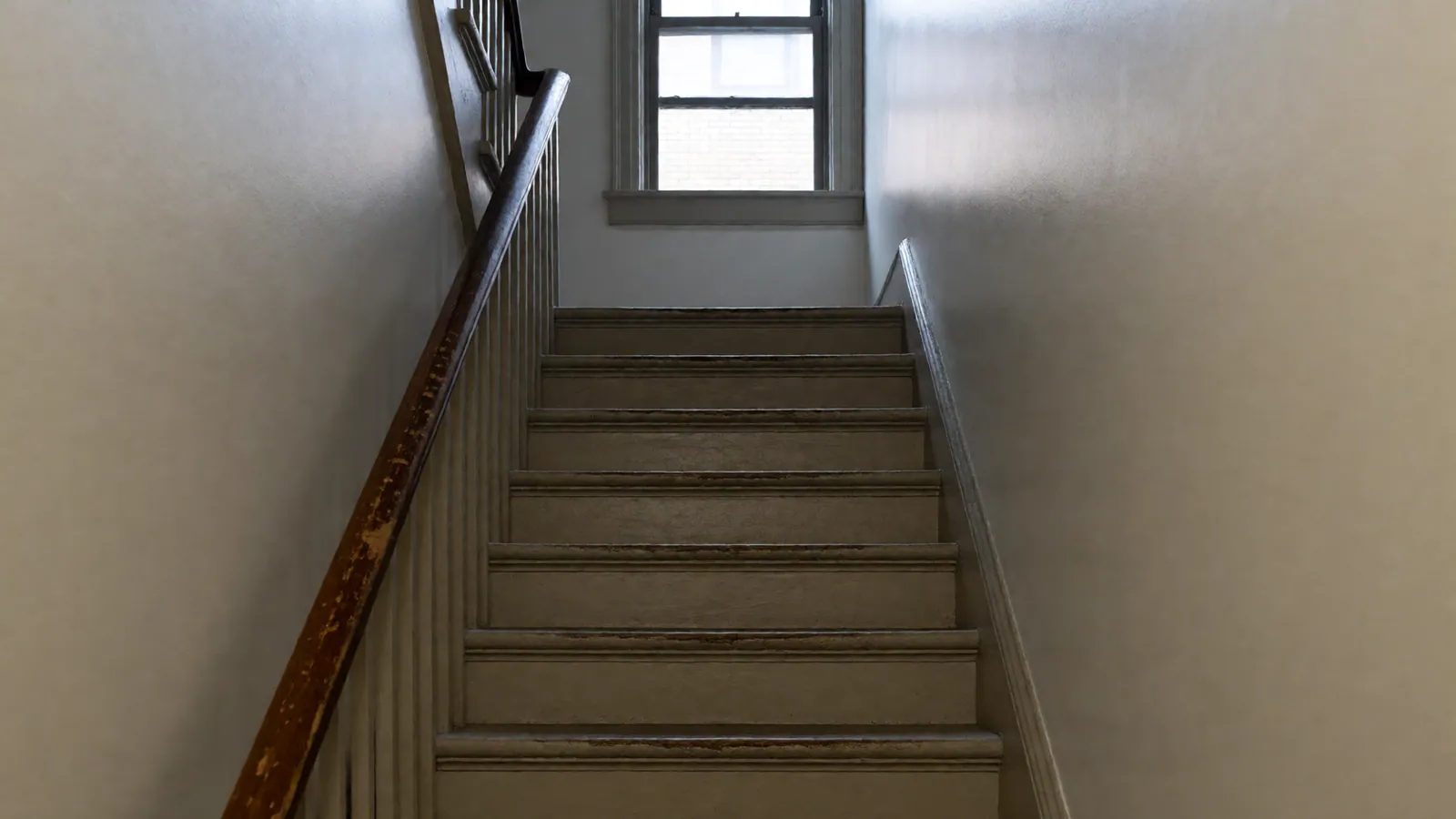
Three flights, a narrow turn at the landing
Most of this borough rents rather than owns, and most of what it rents is a walk-up: three or four flights, a turn at every landing too narrow for anything wider than a single carton, and no lift to take the weight for you. Moving out of one is a different job from moving out of a building with an elevator, and it is worth planning as one rather than discovering it on the day.
This building's own end of the job is measured and printed below, on purpose, because the arrival end of a move is the half a walk-up tenant has the least information about in advance.
Why this is a storage problem before it is a moving problem
A walk-up has no lift and, almost always, no basement that belongs to the tenant. Where a building does have a basement it is the boiler room, the laundry and the super's space — not somewhere a renter can leave a box for a fortnight, whatever the two-family house next door might have room for. So a load that would sit in a garage or a basement anywhere else in the country instead has to go down three flights and somewhere else entirely, on the same day the lease ends.
The one seasonal wrinkle worth planning around: the window air conditioner comes out in October and goes back in around May, in a neighbourhood built almost entirely on window units rather than central air. If your move happens to land near either changeover, that is one more heavy, awkward object to carry down separately — and one that does not need a controlled unit, since it is metal and glass rather than anything a season can spoil.
The same shape turns up at both ends of a life in this borough, not only at the start of one: a first apartment with no basement to lean on, and, years later, an older relative's flat, cleared by children who need somewhere to put a lifetime's worth of things while they decide what stays in the family and what does not. A walk-up does not make either decision easier. It just means everything comes down the same three flights whichever direction the move is going.
The order of operations, week by week
Three to four weeks out — reserve the size
The reservation form on this site only looks thirty days ahead, so this is also the earliest day it will actually let you pick one. Decide the size now and the rest of the list gets easier, because everything after this is arranging things around a fixed point rather than around a guess.
Two to three weeks out — decide what is not coming
The single most-skipped step in this whole list. Everything you have not decided about by moving week defaults to "pack it and decide later", and "later" in a storage unit can run to years. Sort it now, while it is still spread out in a flat rather than sealed in a carton. This is also the point to tell a landlord or a neighbour if the building needs notice to hold a hallway or a stairwell door open — most walk-ups do, informally if not on paper.
The week before — pack with the back of the unit in mind
What you are certain you will not touch for months goes in cartons first, at the back. What you might still need before the unit is properly settled — tools, an inventory list, the lock itself — goes last, near the door, where you can reach it on move-in day without unpacking anything else first.
Moving day — down three flights, then across the yard
The narrow part of the job is entirely at the departure end — the stairs, the landing, the turn nobody designed with a wardrobe in mind. Once a load reaches this building it moves once through a level bay onto a trolley and once up a lift, both wider and easier than anything you have just carried down.
After — sweep the old place, check the new unit
Leave the flat the way the lease asks and take a photograph of the loaded unit before you lock it — the only record either of us has of what went into it.
The two things people always leave too late
The first is treating the loading bay as something you can book by the hour. You cannot — what you can reserve in advance is the day, not a time slot, and the bay itself is first come on the day. It takes two vans at once, which is normally plenty, except on a Saturday morning, which is the busiest four hours of the week here. Plan to arrive early rather than assuming a space will be waiting.
The second is treating "what am I keeping" as a decision that happens during the pack rather than before it. It is the slowest part of the whole job precisely because it feels like it should be the fastest — you are not deciding whether something fits in a box, you are deciding whether you want it at all, and that decision does not go faster because a van is waiting outside.
Both have the same fix, and it is a cheap one: stop treating the unit as the last step of the move and start treating it as the first thing you plan, before a single carton is taped shut. Everything else on this page follows from doing that one thing a week earlier than feels necessary.
What this building actually measures
- The office door is at street level with no step, which matters if a hand truck or a trolley of your own is coming in with you rather than staying in the van.
- The loading bay is level with the yard — no ramp, no lip and no kerb between a van and a trolley, and it takes two vans at the same time.
- The goods lift takes a loaded trolley and two people, and reaches every floor.
- Every corridor is at least five feet wide.
- A unit on the fourth floor is about forty feet of corridor from the lift — not far, but worth knowing before you are the one pushing the trolley.
How to pack the unit once you are here
Hold a unit for the day you are moving
Pick a size and a move-in date in the next thirty days, and one unit of that size comes out of the pool and waits for you. Nothing is paid, nothing is signed, and the form will not offer you a day on which that size is full.